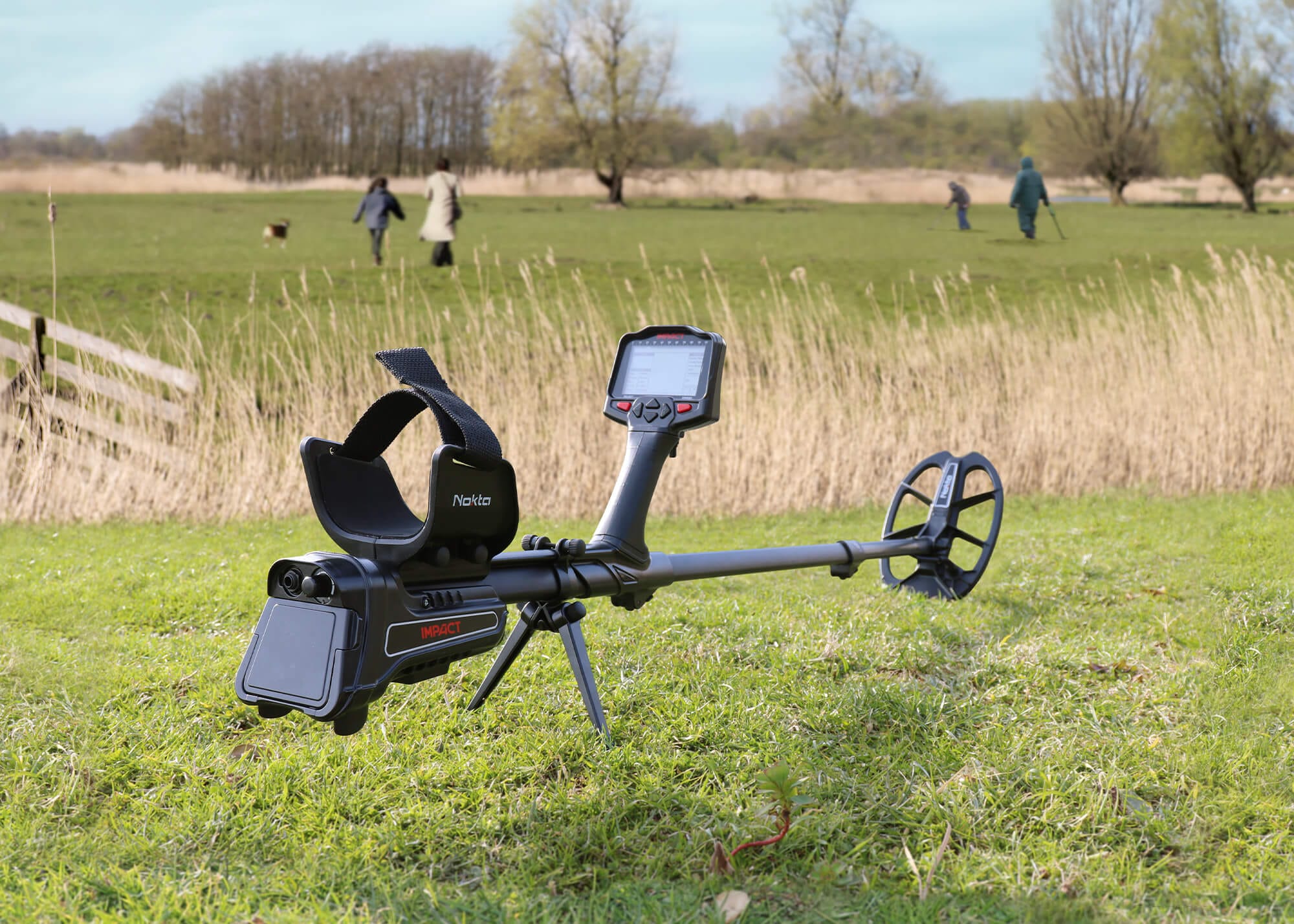
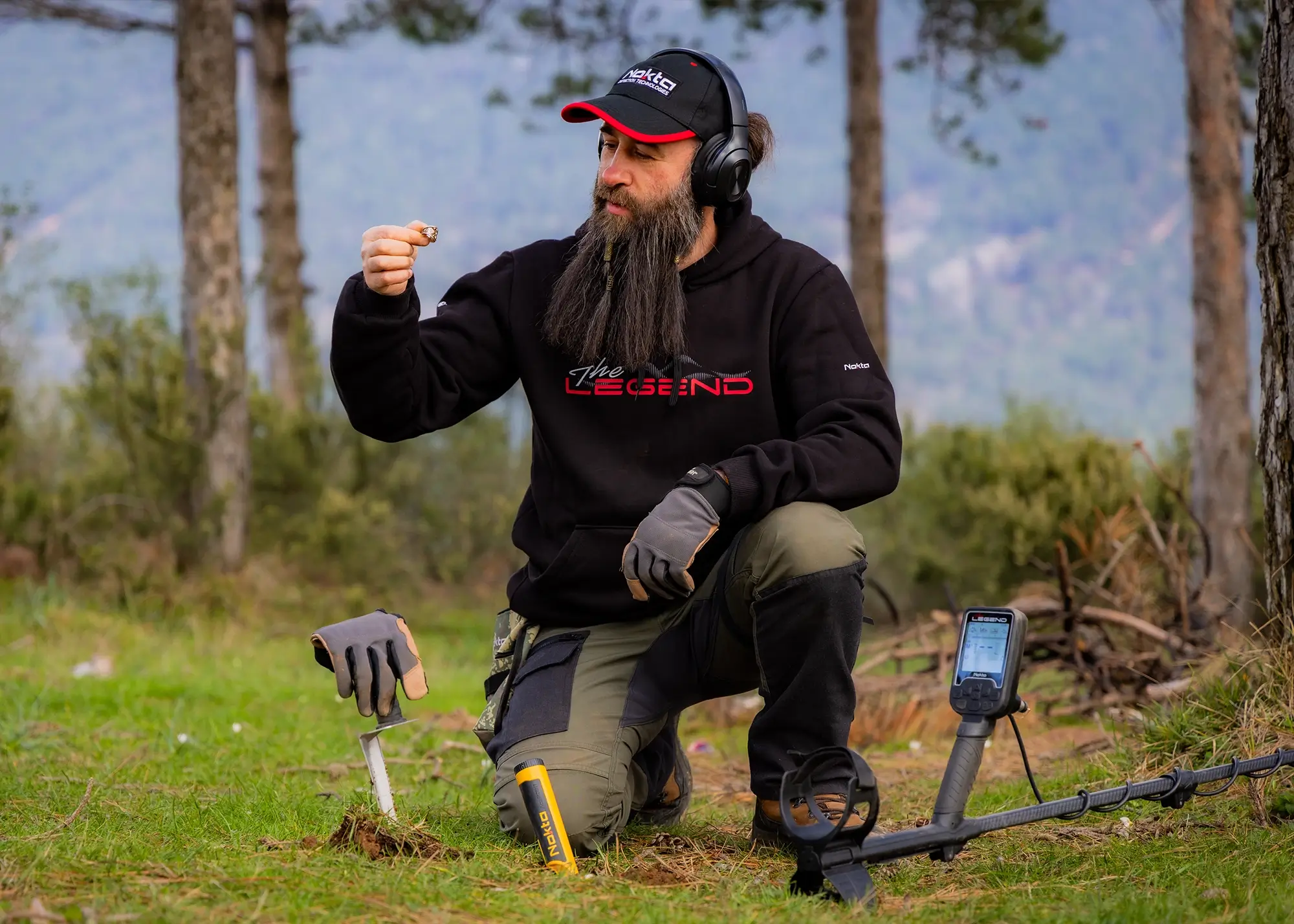
A modern detector gives you a number, a tone and often a depth reading for every target. Beginners treat those as a verdict; experienced operators treat them as evidence. Learning the difference is what separates a productive day from a bag of bottle caps — or worse, from walking over the find of the season because the screen showed the wrong number.
Where the target ID number comes from
On a VLF or multi-frequency machine, the returning signal is shifted in phase relative to the transmitted one, and the size of that shift depends on the conductivity and shape of the target. The detector maps that shift onto a scale — typically iron at the bottom and high-conductive metals like silver at the top. The Minelab Equinox 900 runs ferrous from −19 to 0 and non-ferrous from 1 to 99; the Nokta Simplex Ultra uses a 01–99 scale.
The number is a measurement of electrical behaviour, not an identification of the object. A large iron object can read high. A small gold ring can read in the same range as foil, because electrically they are similar. This is not a defect in the machine — it is the physical limit of what phase shift can tell you.
Why gold is the hardest thing to identify
Gold has a wide and inconvenient ID range. A small, thin piece of gold behaves electrically much like aluminium foil or a pull-tab; a larger piece reads considerably higher. There is no gold-only region of the scale, which means any discrimination pattern aggressive enough to reject foil and pull-tabs will also reject small gold.
This is precisely why dedicated gold machines have minimal discrimination and why serious prospectors dig nearly everything. If your objective is gold, discrimination is not your friend.
The four controls and what they really do
Discrimination — Silences targets below a threshold on the ID scale. Simple, and blunt — everything below the line disappears whether it is a nail or a gold stud.
Notch — Silences a specific band while leaving those above and below audible. Far more surgical than plain discrimination — use it to reject a specific local nuisance target.
Tone breaks — Assigns different audio pitches to ID regions rather than silencing anything. The best of both: you hear everything but know instantly which range it fell in.
Iron bias / iron volume — Adjusts how aggressively the machine rejects signals it judges ferrous. Set too high, it will reject a good target sitting next to a nail — a very common situation on old ground.
The case for discriminating as little as possible
Every rejected target is a signal your machine has decided you do not want to hear, and the decision is made on one narrow piece of evidence. On old sites, good targets frequently lie beside iron, and a machine set to reject iron hard will mask them. Deep targets also read less reliably than shallow ones, so a discrimination pattern tuned on surface trash will silence deep finds.
The better habit is tones. Set tone breaks so that iron growls low and non-ferrous rings high, then use your ears rather than the screen. You will dig more trash. You will also stop missing things, and you will develop the judgement that no screen provides.
Reading a target properly before you dig
Sweep from several directions — A good non-ferrous target holds a consistent ID from most angles. Iron often changes dramatically as you cross it.
Listen to the shape of the signal — A sharp, symmetrical response usually means a compact target. A broad, drawn-out one often means something large, deep or irregular.
Check ID stability, not the number — A steady 62 is far more promising than a reading that jumps between 20 and 80.
Trust depth readings loosely — Depth indicators are calibrated to a coin-sized object. A larger target reads shallower than it is; a smaller one reads deeper.
Dig the repeatable uncertainties — If a signal is consistent but the ID is ambiguous, that is exactly the target most people leave behind.
Machines that make this easier are the ones with clear tone control and a legible scale — Garrett's ACE interface is well regarded for exactly this reason, and Nokta's tone options across the Simplex and Legend lines are unusually flexible for the price.