Every metal detector does the same three things: it pushes an electromagnetic field into the ground, it listens for the field a buried metal object sends back, and it decides whether that returned signal is worth telling you about. Everything else — the price, the screen, the number of modes — is a consequence of how well the machine does those three things in your particular soil. Understanding the mechanism is the fastest way to stop buying on specification sheets and start buying on suitability.
The coil is a transmitter and a receiver
Inside the search coil are at least two windings. The transmit winding carries an alternating current, which generates a magnetic field that penetrates the soil. When that field passes through a conductive object — a coin, a nugget, a buried pipe — it induces small circulating currents in the metal, known as eddy currents. Those eddy currents generate their own weak magnetic field, and the receive winding picks it up. The difference between what was sent and what came back is the target signal.
This is why coil size matters more than most buyers expect. A large coil pushes a broader, deeper field and covers ground faster, but it averages everything under it into one reading and struggles to separate two targets lying close together. A small coil sees a narrow patch, but it resolves individual targets cleanly and handles trashy or heavily mineralized ground far better. That is the reason a machine like the Minelab GPX 6000 ships with both an 11-inch mono and a 14-inch DD coil rather than one compromise coil.
VLF: induction balance at a single frequency
Very Low Frequency detectors transmit continuously at a fixed frequency, typically between 4 kHz and 61 kHz, and use the phase shift of the returning signal to work out what the target is made of. Because different metals shift the phase by different amounts, a VLF machine can tell you that a target is probably iron, probably foil, or probably silver — before you dig. That is where target ID numbers and discrimination come from.
Frequency choice is a genuine trade-off, not a marketing number. Lower frequencies couple better with large, highly conductive targets and reach deeper; higher frequencies are far more sensitive to small, low-conductivity targets such as fine gold. The Nokta Gold Finder 2000 runs at 61 kHz precisely because it is built to find small nuggets, while a general-purpose machine like the Garrett ACE 200i sits at 6.5 kHz for coins and relics.
Pulse induction: power at the cost of discrimination
Pulse induction works differently. Instead of transmitting continuously, a PI detector sends short, powerful pulses into the ground and then listens, during the silence between pulses, for the decaying eddy currents in a buried target. Because it is not trying to balance a continuous signal, ground mineralisation upsets it far less. That is the entire reason PI dominates serious gold prospecting in hot ground.
The cost is discrimination. A PI machine measures how long the target signal takes to decay, which distinguishes large from small and conductive from less conductive, but it cannot separate metal types with anything like VLF precision. In practice a PI operator digs almost everything. On clean ground that is a nuisance; in mineralised gold country it is an acceptable price for depth that VLF cannot reach.
Simultaneous multi-frequency: the modern compromise
Simultaneous multi-frequency machines transmit several frequencies at once and combine the responses. This gives a machine sensitivity to both small low-conductive targets and large high-conductive ones at the same time, and it gives the processor far more information to subtract ground mineralisation from the target signal. Minelab's Multi-IQ and Nokta's SMF implementations are the two you will meet most often in this catalogue.
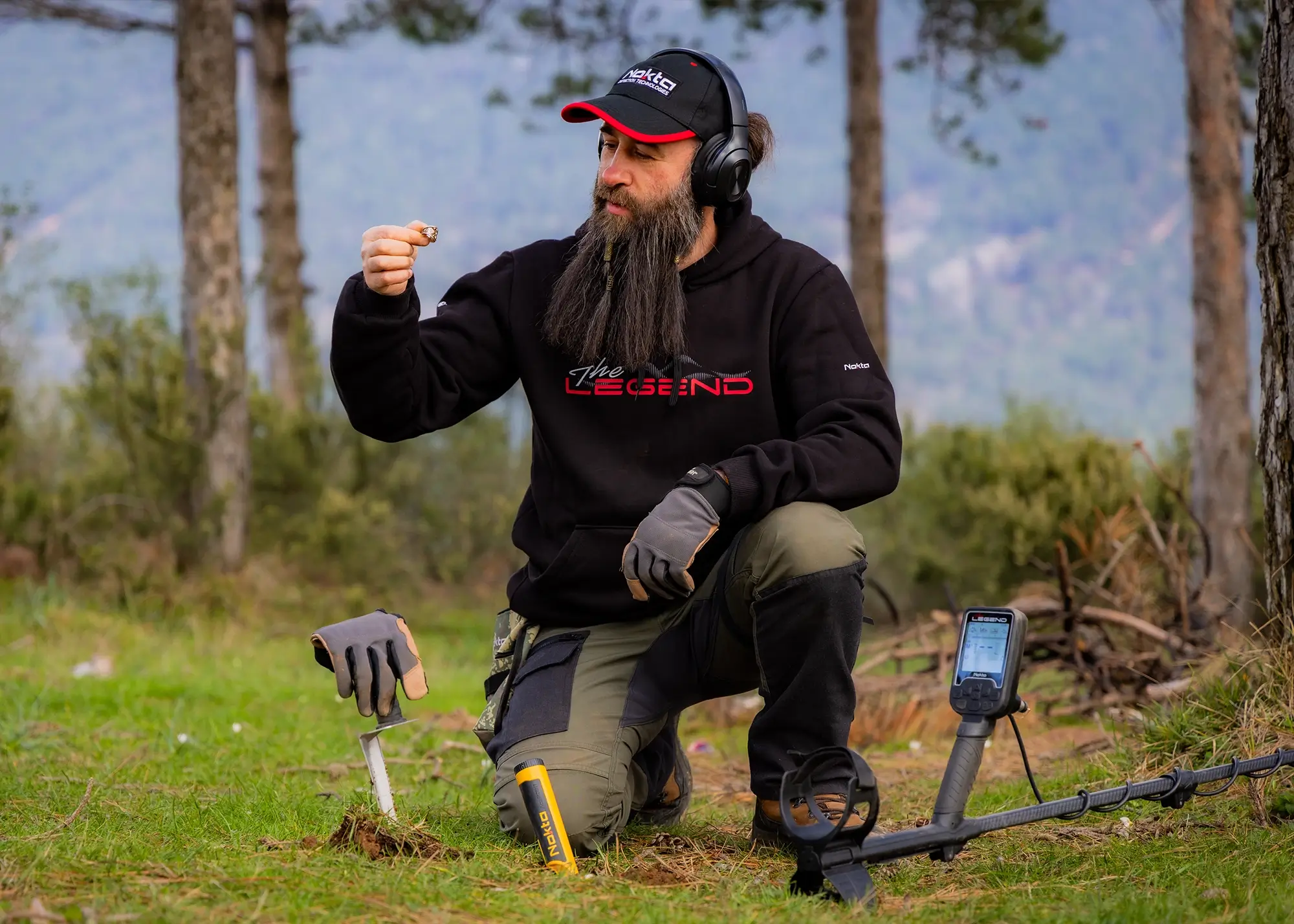
This is why a Nokta The Legend at PKR 295,000 can hold its own against machines that cost several times more on ordinary ground: multi-frequency closed most of the practical gap for coin, relic and beach hunting. Where it does not close the gap is deep gold in severely mineralised soil, which remains PI territory.
| VLF | Pulse induction | Simultaneous multi-frequency | |
|---|---|---|---|
| Best at | Coins, relics, jewellery, fine gold | Deep gold in hot ground | Mixed use, beach, general hunting |
| Target ID | Excellent | Very limited | Excellent |
| Mineralised soil | Struggles without careful ground balance | Largely unaffected | Handled well by processing |
| Salt / wet sand | Difficult at high frequency | Good | Excellent |
| Example in stock | Nokta Simplex Ultra, Garrett ACE 300i | Minelab GPX 6000, GPZ 7000 | Nokta The Legend, Minelab Equinox 900 |
Ground mineralisation is the variable that decides everything
Soil containing iron oxides, salts or magnetite returns its own signal, and that signal is often far stronger than the one coming from a small piece of gold. Every detector has to subtract it, either through ground balancing on a VLF machine or inherently through the PI timing cycle. When you read a depth figure on a specification sheet, it was measured in conditions far kinder than most Pakistani gold country.
This is the single most important thing to take away: technology choice should follow your ground, not your budget. A buyer in a river valley with mild soil gets more from a good multi-frequency machine than from a pulse induction detector costing four times as much. A buyer working mineralised country gets the opposite answer.
What to check before you commit
Name your ground first — Mineralised, mild, wet salt sand or freshwater — this decides technology before anything else does.
Match frequency to target size — Fine gold wants high frequency or PI. Coins and larger relics want lower frequency or multi-frequency.
Treat depth claims as ceilings — Manufacturer figures describe a large target in favourable soil, not a small one in hot ground.
Buy the coil options, not just the machine — A second coil often changes performance more than moving up a price tier.
If you can tell us the district you intend to work and the size of target you are after, we can narrow 58 machines down to two or three in a single conversation — and tell you honestly when the cheaper one is the right answer.